It is quite interesting to learn about the first ever electric telegraph in the 18th century.
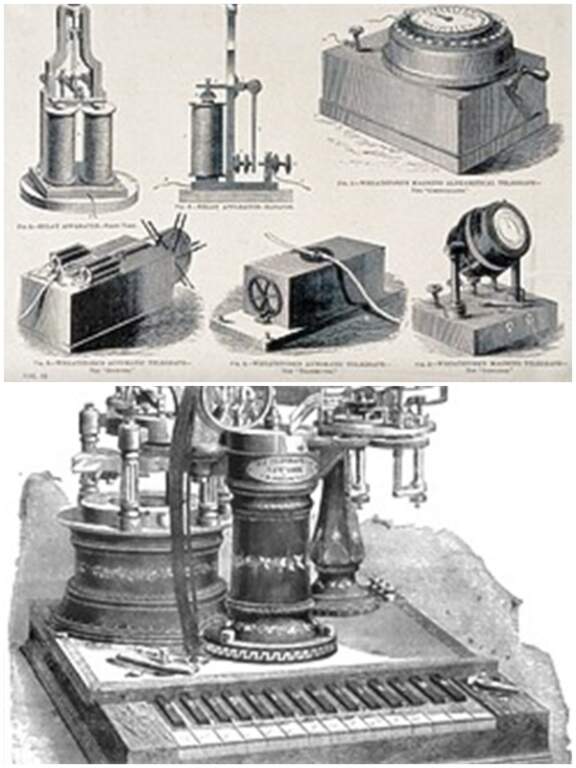
Before the end of the 1830s, it became clear that if railways were to be safe and efficient, some means must be found for communicating, along the line, both the impending approach of trains and their successful arrival (which would leave the line free for new traffic). The solution was Charles Wheatstone’s electric telegraph, the first practical use of a current provided by a battery. This was first installed commercially in 1838, when the Great Western Railway laid a line between Paddington and Slough, opening a new era in railway signalling.
The receiving terminal consists of a compass needle placed between two poles of an electric magnet. The sending terminal consists of a handle with three positions. In the central position no current flows, so the electromagnet at the receiver is not energized, and the compass needle also remains in the central position. Turning the handle either way, clockwise or anticlockwise, then switches on a current whose direction makes the compass needle turn the same way. With three possible positions at both terminals, the receiver mimics the sender.
With each position coded for a specific signal, ‘line blocked’, ‘line clear’, ‘train on line’, this became the basic railway block-instrument, still occasionally used to regulate the passage of trains over successive sections of track. A more elementary use of electromagnetism allows a bell code to be sent by telegraph. A key operated by the sender sends a current to an electric magnet connected to the clapper of a bell at the receiving end. Well into the twentieth century, the bell, combined with the telegraph, sent trains safely and at high speed from one end of the country to another.
In the years 1832-35, Samuel Morse, in the United States, invented an alternative electric telegraph, for which he devised the famous Morse code, introduced in 1838. The receiver consisted of an electric magnet, fixed to attract a metal armature. Immediately the circuit was completed, it was broken by the armature being attracted to the magnet.
The magnet lost its power, the armature was released, and the circuit was restored. In this way, the cyclical process could continue indefinitely: the result was a buzz, which the adjusting screw could regulate. Morse saw that by using a key to interrupt the circuit, he could send a code consisting of short and long pulses – the once familiar dots and dashes – so that the two combined could represent all the letters of the alphabet. Soon, skilled operators could send and receive thirty words a minute, over any distance, so long as an electric cable could be laid across it. The first link ever laid down in 1845 was between Baltimore and Washington. Helped by undersea cables, the system would cover the whole world before the end of the century.
Read More: William Shirley – Influential Governor of Massachusetts and the Bahamas