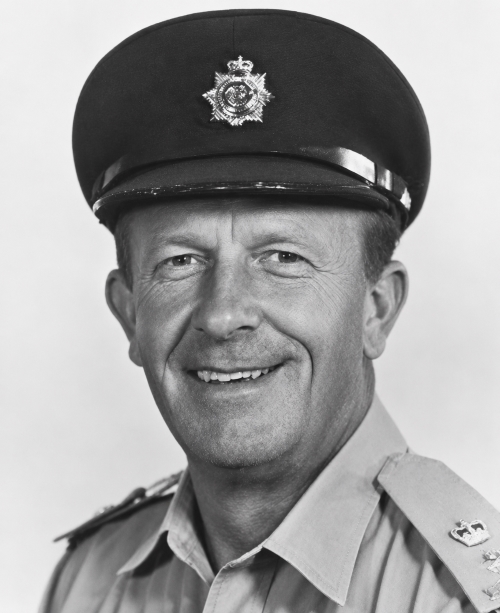
Lieutenant-Colonel A. W. Bewley (his regimental number was 2905) was undoubtedly one of the longest-serving members of the Australian Army Service Corps, the Royal Australian Army Service Corps, and its successor, the Royal Australian Corps of Transport.
Born on 8 June 1925, he was christened Alexander William, but for at least 35 years—which is as long as I have known him—he has been called Allan; why, I have often wondered, but never remembered to ask him.
He enlisted in the Citizen Military Forces five months before his seventeenth birthday and began his long association with the Corps on 26 February 1942, when he was posted to the Newcastle Covering Force Supply Column for a month, followed by ten months as a driver with the 22nd Field Ambulance. On 8 January 1943, he enlisted in the 2nd Australian Imperial Force. In June of that year, he turned eighteen, and on 17 October he went to New Guinea. For the remainder of the Second World War, he served there and on Bougainville with a motor ambulance convoy.
Still on Bougainville, he was posted as an acting corporal to 253 Supply Depot Platoon. He moved with that unit to Morotai in November 1945 and, the following February, to Japan as part of the British Commonwealth Occupation Force (BCOF, pronounced bee-coo-eff).
Lieutenant-Colonel A. W. Bewley had his acting rank confirmed on 22 May and was promoted to acting sergeant on the same day. On 20 June, he was made a substantive sergeant, transferred from the AIF to the Interim Army on 1 July, and then to the Australian Regular Army on 9 December. He was posted to the headquarters of the 41st Advanced Supply Depot Platoon on 17 December 1947. He was still serving there when, on 31 December 1948, the designation “Royal” was conferred on the AASC.
The BCOF was beginning to thin out—most of the British and all of the Indian units had already departed—when the Korean War erupted in mid-1950, greatly increasing the workload in the Australian supply units. On 25 January 1951, our subject was posted to the BCOF Field Bakery Platoon and promoted to temporary warrant officer class 1.
On 10 February 1952, his service in Japan came to an end after a historic six years. By then, he was wearing the 1939/45 Star, the Pacific Star, the War Medal and the Australia Service Medal for his Second World War service, as well as the United Nations Service Medal for the support his units had provided during the Korean conflict.
Reverting to temporary warrant officer class two, on 5 June 1952 at his own request, he took up a posting to 101 Supply Depot Platoon at (I think) Ashgrove in Brisbane. From there, he attended the Officer Qualifying Course at the School of Tactics and Administration at Seymour in Victoria and was commissioned as a lieutenant in the Australian Staff Corps on 11 April 1953.
Lieutenant-Colonel A. W. Bewley’s first appointment was to Headquarters, Tasmania Command Troops, RAASC. He was made captain on 11 April 1957 and joined the staff of the RAASC School at Puckapunyal on 30 July as the Senior Instructor of the Air Dispatch Wing. This was an onerous task for two main reasons: air supply was then being reinvented after a hiatus dating back to the days of the “biscuit bombers” in New Guinea, and new doctrine, techniques and equipment had to be developed. The Chief Instructor of the School was the redoubtable Lieutenant-Colonel S. R. Birch, who greatly influenced the Corps for a generation by setting extremely high standards for himself, the students—of whom I was one—and, as Allan Bewley will attest, his instructors.
That the then Captain Bewley acquitted himself well is evident from the series of postings and promotions that followed. He became one of the Army’s foremost experts on air supply and Army/Air Force co-operation.
He served with the Far East Land Forces (FARELF) in Singapore from 2 October 1959 to 2 December 1961, and was back at what had by then become the RAASC Centre at Puckapunyal early the next year. On 10 May, he was promoted to temporary major and attached to the RAAF pending his movement to the United States, where he underwent training in air transport technique from 18 June to 25 September 1962. On his return to Australia, he was again attached to the RAAF, this time for duty with 86 Transport Wing.
On 11 April 1963, Lieutenant-Colonel A. W. Bewley achieved the substantive rank of major, and a few weeks later was appointed the air supply instructor at the Air Movement Training Flight. He became the Commanding Officer of the Army Air Supply Organisation (1 AASO, the predecessor of today’s Air Transport Support Regiment) on 18 October 1965.
Australia’s commitment to the war in Vietnam could not be met from the resources of the standing Regular Army, so the two-year national service scheme was introduced, including an officer-producing establishment. National Service soldiers were excellent material, and those selected to attend the Officer Training Unit at Scheyville were the cream of the crop. Their training had to be extremely intensive to realise their potential within the time available, and the administration required to support it had to be very good indeed. Allan Bewley was the Administration Major from 9 January 1967 to 17 January 1969 and carried out the role with distinction.
Then he was promoted to temporary lieutenant-colonel on 17 January 1969; he was appointed Commanding Officer of the 1st Ground Liaison Group, the Army’s advisory and liaison organisation attached to the RAAF’s Operational Command at Lapstone in New South Wales. His lieutenant-colonelcy became substantive on 23 September of the same year.
After thirty-seven months with the Air Force, he achieved a feat that had fallen to very few since the Korean War: command of a Regular Army regiment-sized RAASC organisation, in this case the 9th Supplies and Transport Corps at Randwick. He joined it on 2 February 1972 and was still commanding it when the RAASC ceased to exist, and the Royal Australian Corps of Transport was born on 1 June 1973. He was, therefore, one of the new Corps’ most senior foundation members. He had, by then, qualified for the additional awards of the Defence Force Service Medal with bars.
For his last posting, he returned to the 1st Ground Liaison Group, where he served as the Commanding Officer from 11 December 1973 until 9 June 1975. He was then placed on the Retired List the following day after thirty-three and a half years of service.
Since then, he has run a very successful wholesale plant nursery from his home, which is set on several beautiful hectares at Warrimoo in the Blue Mountains. He shares the home, and a very active interest in community affairs, with his delightful lady, Lorraine. His many and continuing contributions on both the local and wider scene include a long and vigorous association with the Scouting Movement at group, district and area levels, and with Legacy.
Lieutenant-Colonel A. W. Bewley’s service to the Corps did not end with his retirement from the Regular Army. On 21 May 1979, he graciously accepted appointment as the Colonel Commandant of the RACT in the 2nd Military District, a position he held until 21 July 1983, including an extension of two months to enable him to host the parade and celebrations to mark the tenth birthday of the RACT. Those celebrations were a fitting climax to his tenure as Colonel Commandant and Chairman of the Colonel Commandants’ Committee. Lieutenant-Colonel A. W. Bewley, you will be remembered forever.
Read More: The Creek Wars